
In the actual business of many teams, Telegram screening is done manually at first. Data is imported, detected, and then exported. The process seems simple, but once the amount of data increases, it will soon get stuck. It's not that the sifting can't be done, but that the whole process is starting to become unsmooth and there are more and more repeated operations.
At this time, the problem is no longer the screening number itself, but that the screening step is not integrated into the system. Integrating the Telegram number detection API into the business system is essentially solving one thing, allowing the data to be filtered automatically during the flow process, instead of requiring human intervention every time.
Why the API method is more suitable for long-term use
Manual screening is more like a one-time action, while API is more like a "continuously running link". When data is constantly flowing in, such as new leads and numbers every day, it is difficult to maintain efficiency and stability if it is processed manually every time.
The value of the API is that it can turn screening into a fixed step. The data is automatically detected as soon as it comes in, and the results are returned directly without additional processing. Over time, this step will become like infrastructure rather than extra work.
CRM system: let sales get all available users
In a CRM system, the most immediate issue is lead quality. If there is a problem with the imported number itself, it is easy to be unreachable and unresponsive during sales follow-up.
By connecting the Telegram number detection API to the CRM, the filtering can be completed when the data enters the system. The simple understanding is that what sales see is not the original list, but the filtered results.
The changes brought about by this are very direct, follow-up is more efficient, and it is easier to judge the value of customers instead of spending time to verify whether the number is available.
SCRM and private domain systems: Make user stratification clearer
When doing private domain, user stratification is the basis. If the data is not filtered and all users are mixed together, it will be difficult to conduct refined operations.
Through API access, users can mark their status when they enter the system, such as whether they are registered in Telegram and whether they are active. Later, when grouping and reaching, you can operate directly based on these tags instead of additional filtering.
The advantage of this approach is that screening and operation are connected together rather than two separate steps.
Group control system: reduce invalid actions
When using a group control system, the biggest fear is a large number of invalid operations, such as sending messages to unregistered users or reaching low-active accounts. Such behavior not only wastes resources but may also bring risks.
If you access the detection API before the group control process, you can filter out unavailable data before performing the operation. In this way, every contact will be more focused and closer to real users.
Judging from the results, the sending volume may decrease, but the effective reach ratio will increase.
Data platform: Make the data structure cleaner
For companies with data teams, the data platform is the core link. If the underlying data is messy, subsequent analysis and decision-making will be affected.
By connecting the Telegram number detection API to the data platform, a round of screening can be completed when the data is entered into the database. In this way, the data is not simply stored, but structured data with status tags.
In the future, whether it is analyzing user distribution or making strategic adjustments, it will be clearer.
Marketing automation system: make the process really run
Many teams will encounter a problem when doing marketing automation. The process is well designed, but the execution effect is unstable. The reason is often inconsistent data quality.
If the detection API is embedded into the automated process, users can be automatically screened before each round of contact. This way the process does not require manual intervention and the data remains consistent.
Looking at it as a whole, automation truly becomes "automatic" rather than semi-automatic.
This method is easier to implement when using Amman
In actual access, the most critical thing is not whether there is an API, but whether it can be used stably. Whether the interface supports batch processing, whether the returned results are clear, and whether it can be directly used in business logic will all affect the actual effect.
This method like Amman is more suitable for direct embedding into existing systems. The detection is completed when the data enters, and the registration status and activity status are returned. The business system only needs to make allocations based on the results, without additional processing.
Make screening part of the process
Many teams will treat the screen number as a tool at first, but after using it, they will find that it is more like a process node. Only when this step is integrated into the system can the data really run.
When the number detection API becomes a fixed link, many things that originally required manual judgment will be completed automatically. The process has become simpler, the data is more stable, and subsequent operations will naturally be smoother.
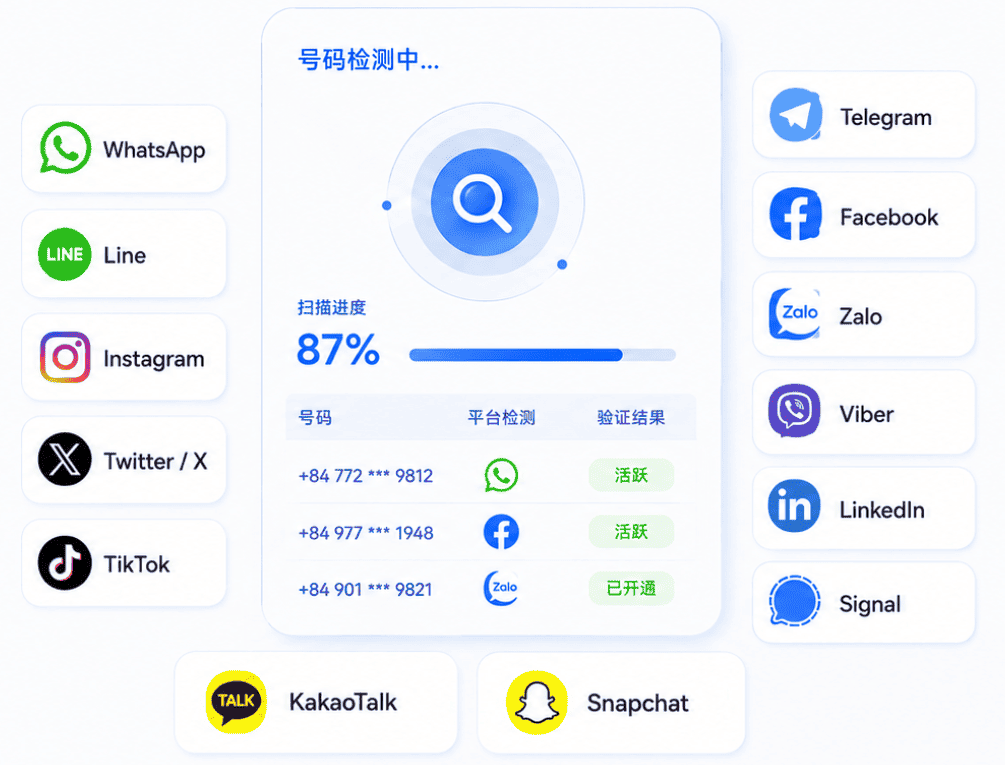
Amman is the world's leading number screening platform, providing global customers with batch number screening and testing services covering 236 countries. The platform currently supports more than 40 mainstream social networking and applications, including WhatsApp, Line, Twitter, Facebook, Instagram, LinkedIn, Viber, Zalo, Binance, Signal, etc., adapting to the needs of multiple scenarios.
The main core functions cover multi-dimensional precise screening such as activation, activity, interaction, gender, avatar, age, online, accuracy, empty account, mobile phone device, etc., and can flexibly meet the needs of different users. Its core advantage is to integrate global mainstream social and application resources to provide users with one-stop, real-time and efficient number precision screening services, helping customers achieve global digital layout.
It is a common choice for all professional teams to complete rational screening before actually reaching users.
Editor abcheck has a lot of experience, welcome to communicate with me, click to contact @Tg8189