
When collecting eBay customer data, mobile phone number is often the most basic piece of information. Numbers may be left in historical orders, product inquiries, member information, and after-sales records, but after these data are stored for a long time, the status may not be the same as before.
Some numbers have been deactivated, some number formats are incomplete, some customer information is saved repeatedly, and some numbers are valid, but it is not possible to confirm whether there is still an eBay-related account status.
Therefore, eBay mobile phone number verification is not simply to check "whether this number can be connected", but to sort out the number itself first, and then add the relevant status of the platform to make the old customer information clear again.
What problems does eBay mobile phone number verification mainly solve?
The simplest way to understand it is to confirm the basic status of the mobile phone number and then check whether there are eBay-related platform attributes.
For example, the customer table only contains:
Mobile phone number, country, customer source.
After finishing, you can continue to add:
Whether the number is valid, whether there is eBay related status, data update time and other information.
This way, when you use customer information later, you don't have to rely solely on notes left a few years ago.
Especially when there is a lot of historical data, this kind of verification will be very practical.
Which eBay numbers are most worth re-verifying?
Not all numbers require frequent testing.
What is more worthy of reorganizing is usually the following types of data:
Historical order customers, old customers who have not been contacted for a long time, mobile phone numbers exported from the old CRM, data merged from multiple activities, and eBay-related user information summarized from different channels.
The biggest thing these numbers have in common is that they "take a long time."
The number may be fine when it first enters the system, but it will need to be reconfirmed if it can still be used after a few years.
The first step is to process the number format first.
Before verifying your mobile phone number, don’t rush to check the platform status.
If there is a problem with the basic format, the subsequent results will also be messed up.
For example, some U.S. numbers have +1, some have no country code; some numbers have spaces or dashes in the middle; and some numbers are obviously the wrong length.
The simpler processing sequence is:
First unify the country area code, then unify the number format, and finally clean up the obviously erroneous data.
This way, when doing eBay mobile phone number verification later, the results will be easier to sort out.
The second step is to clear out duplicate numbers.
Duplicate numbers are a very common problem in old customer data.
The same customer may have placed multiple orders, or may have inquired about different products, which are saved each time.
It looks like there are 100,000 pieces of data in the final table, but the actual independent numbers may not be that many.
Therefore, it is best to remove duplicates before verification.
But please note that deduplication does not mean deleting customer history records altogether.
The correct approach is to keep only one mobile phone number, and at the same time keep past orders, inquiries, sources and other information.
In this way, detection will neither be repeated nor historical customer information lost.
The third step is to check the basic validity status of the number.
After the number format is sorted, you can continue to check whether the number itself is still suitable for use.
If the number has obviously expired, is in abnormal status, or cannot continue to be used as a normal contact method, it can be placed separately in the abnormal data first.
In this way, when doing verification related to the eBay platform later, there is no need to let the obviously problematic number continue to enter the detection process again.
This layer is actually doing "number quality inspection".
It will be easier to deal with the quality of the basic number first, and then check the platform account status.
The fourth step is to check the eBay related account status.
After there are no obvious problems with the number itself, you can add eBay related status.
In this way, ordinary mobile phone numbers can continue to be divided into different ranges.
For example, data that detects eBay-related status can be saved separately, data that does not detect the corresponding status enters another range, and data that cannot be confirmed temporarily can also be kept separately.
After processing in this way, the customer information will be clearer than before.
It used to be possible to just write "eBay customer", but now you can further know whether the basic status of the number and the status related to the platform have changed.
Shi'anman is suitable for batch review of eBay customer information.
When there are only a few hundred historical eBay customers, it is still acceptable to organize them in tables.
But if the numbers are tens of thousands or hundreds of thousands, and they come from the United States, the United Kingdom, Germany, Japan and other countries, manual sorting will be slower.
In this kind of situation, you can sort out the batch numbers and platform-related status through Amman.
Supported by Shi AmmanAutomatic adaptation of 200+ country and region codes, you can first identify different country numbers, and then continue to conduct eBay-related testing based on the corresponding products.
When the amount of data is relatively large, you can useMillion-level file concurrency detectionProcess historical files to reduce the need to continuously split tables, upload them in batches, and then re-merge the results.
After the screening is completed, the results can be exported and merged with the original order, customer source, country and other information.
Here, Shi Anman is more suitable as a "batch review tool for old eBay customer information" rather than simply using it to find new users.
How to classify after the verification is completed is more practical
Do not put all the numbers back into a master list after verification.
It can be simply divided into several ranges.
Data of recent customers and numbers with normal status and clear platform-related status can be placed in the priority customer pool.
Historical customers and data whose numbers are still valid but have not been interacted with for a long time can be placed in the general maintenance pool.
Data with abnormal numbers and unclear status can be entered into the scope to be reviewed.
Data that has become obviously invalid are archived separately.
In this way, when you need to check customers in the future, you can search directly from the corresponding range.
eBay account status cannot replace customer history
Some numbers detect platform-related status, but whether this user is an important customer depends on the actual past records.
For example, a customer has made multiple purchases, inquiries, or after-sales records. This information is more valuable than simply "having an eBay account."
Conversely, although a number has platform-related status, it does not have any orders, inquiries or business sources, and cannot be directly regarded as a high-value customer.
Therefore, mobile phone number verification only adds labels to customer information.
To truly judge customer priorities, you still need to see whether there are real business relationships in the past.
It is best to keep the latest update time for historical customers
After completing the verification, you can easily add a "last update time" to the customer.
for example:
Re-verified in August 2026.
If you see this data in the future, you will know that this number has not been left untouched a few years ago, but has been rechecked recently.
This little label is very useful.
Especially when the customer database is relatively large, data that has not been updated for a long time can be prioritized and there is no need to recheck all numbers every time.
If you want to add eBay data in the long term, you can consider the API.
If new customer mobile phone numbers enter every day, long-term manual uploading will be troublesome.
At this time, you can consider using Amman's API capabilities to integrate part of the detection process into the existing system.
After the new number is entered, basic testing is completed according to fixed rules, and the results are written back to the original customer information.
If you only organize historical data once in a while, uploading the file directly is enough.
There is no need to complicate a simple process in order to use an API.
What eBay mobile phone number verification really solves is the aging of customer information
The problem with many eBay customer data is not that there is no mobile phone number, but that the data has been stored for too long, and the number and platform status are no longer clear.
First unify the number format, then remove duplicates, check the basic valid status, and finally add the eBay related account status to rearrange the old data clearly.
Shianman can use global number adaptation, large-volume file processing and platform-related detection capabilities to help batch review historical eBay customer information.
The truly practical result is not just to get "Does this number have an eBay account?", but to make the status, source and update time of the customer number more clear, making subsequent search, maintenance and classification much easier.
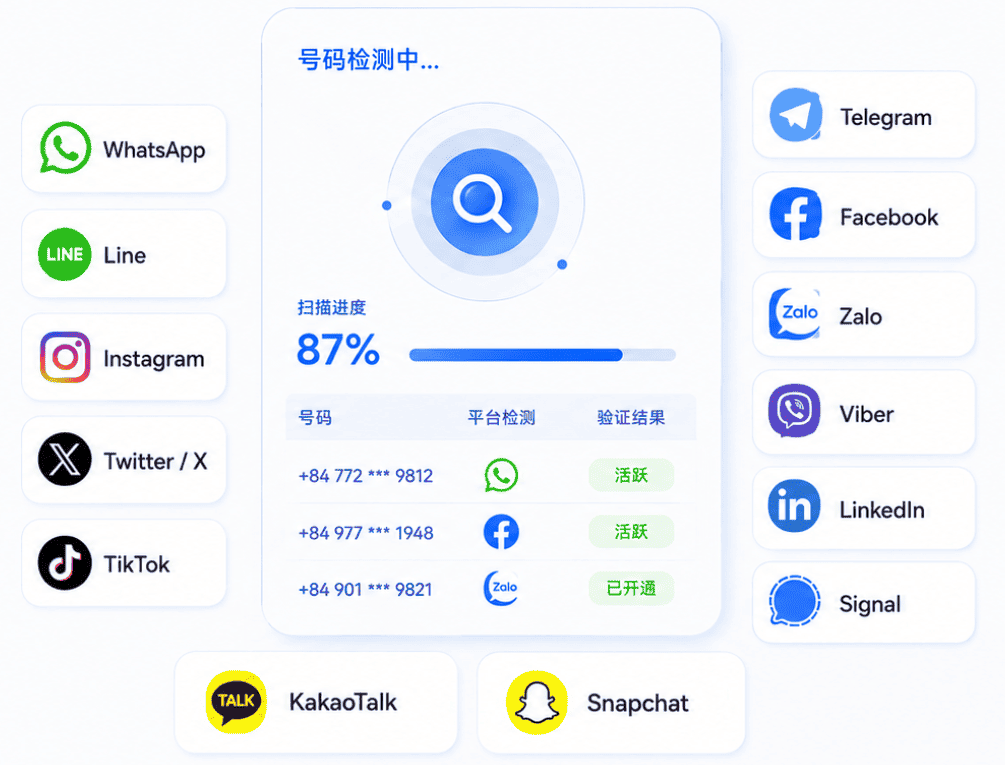
Amman is the world's leading number screening platform, providing global customers with batch number screening and testing services covering 236 countries. The platform currently supports more than 40 mainstream social networking and applications, including WhatsApp, Line, Twitter, Facebook, Instagram, LinkedIn, Viber, Zalo, Binance, Signal, etc., adapting to the needs of multiple scenarios.
The main core functions cover multi-dimensional precise screening such as activation, activity, interaction, gender, avatar, age, online, accuracy, empty account, mobile phone device, etc., which can flexibly meet the needs of different users. Its core advantage is to integrate global mainstream social and application resources, provide users with one-stop, real-time and efficient number precision screening services, and help customers achieve global digital layout.
It is a common choice for all professional teams to complete rational screening before actually reaching users.
Editor abcheck has a lot of experience, welcome to communicate with me, click to contact@Tg8189